

Why I Use Tile Levelling Clips (And What They Actually Do)
- paul finn
- Jan 29
- 2 min read

If you’re investing in large-format porcelain tiles, one of the biggest things that affects the finished look isn’t the tile itself — it’s how flat the floor ends up.
That’s where tile levelling clips come in.
They’re not a gimmick, and they don’t replace proper preparation. Used correctly, they’re a precision tool that helps deliver a flatter, cleaner finish — especially on modern porcelain floors.
What Are Tile Levelling Clips?
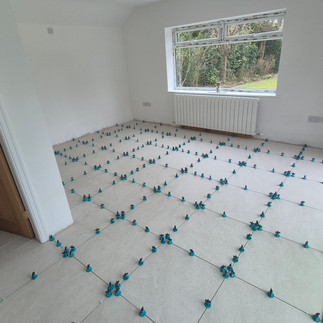
Tile levelling clips are part of a mechanical system used during installation to help keep neighbouring tiles perfectly aligned while the adhesive cures.
They work by:
Holding adjacent tiles at the same height
Reducing lippage (where one tile edge sits higher than the next)
Locking tiles in position while the adhesive sets
Once the floor has cured, the clips are removed cleanly, leaving no visible fixings behind.
What Levelling Clips Do Not Do
This is important.
Levelling clips do not fix a bad subfloor.
If the floor underneath isn’t flat:
Clips won’t straighten it
They won’t compensate for poor preparation
And they won’t stop long-term movement
That’s why, before a single tile goes down, I focus heavily on:
Floor assessment
Levelling where required
Correct adhesive choice and coverage
Clips are the final refinement, not the shortcut.
Why They Matter With Large-Format Tiles
Modern porcelain tiles are:
Bigger
Thinner
Harder than traditional ceramics
Even tiny variations in adhesive thickness or tile bow can show up once everything’s laid.
Levelling clips help:
Maintain consistent plane across large areas
Keep grout joints sharp and uniform
Achieve that seamless, high-end look people expect from porcelain
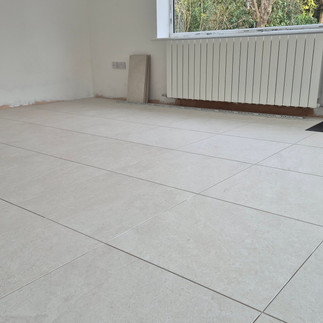
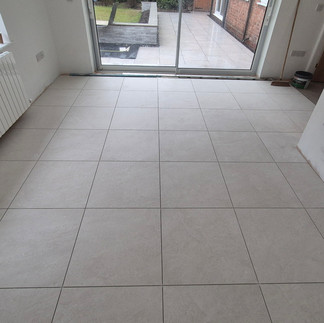
On floors like the one shown here, clips allow the entire surface to read as one continuous plane, not a patchwork of individual tiles.
The Real Benefit: A Better Finished Floor
When levelling clips are used properly — alongside correct prep — the difference is subtle but crucial:
Floors feel flatter underfoot
Light reflects evenly across the surface
Grout lines stay clean and consistent
Furniture sits properly, without rocking
It’s the kind of detail most people don’t notice consciously — but they feel it straight away.
My Approach
I don’t use levelling clips on every job automatically.
I use them when:
The tile format demands it
The space needs absolute consistency
The client expects a premium finish
Combined with proper preparation, they help me deliver floors that don’t just look good on day one — they still look right years down the line.
Contact me for A free Quotation on 01925 899755











Comments